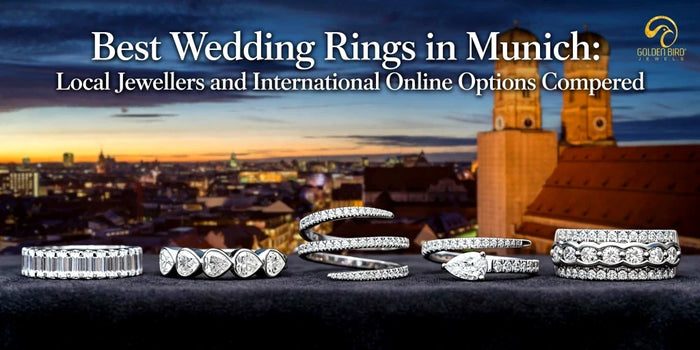
Lab Grown Diamond and Moissanite Wedding Rings for Munich Couples: A Complete Guide

Munich couples shopping for wedding rings in 2026 are landing on the same shortlist: a lab grown diamond or a moissanite. Both are grown in controlled laboratory conditions, both skip the ethical concerns of mined stones, and both look striking set in gold or platinum. The difference lies in chemistry, optical personality, certification, and what happens at the German border when you order from a UK-based jeweller.
That last point matters more than most guides admit. Getting the stone choice right is only half the job. Understanding how IGI grading works, what German customs will charge, and how to order a handcrafted ring from an international retailer without surprises is what separates a smooth purchase from a frustrating one.
What is the actual difference between a lab grown diamond and moissanite?
They are chemically distinct materials. A lab grown diamond is pure carbon, physically and optically identical to a mined diamond, rated 10 on the Mohs hardness scale. Moissanite is silicon carbide, a different gemstone that scores around 9.25 on that same scale.
The optical gap is where the choice gets personal. Moissanite has a refractive index of 2.65 to 2.69 and a dispersion value of 0.104, which is more than double a diamond’s 0.044. In practice, that means moissanite throws off colourful rainbow flashes of light, especially in bright sunshine or under strong indoor lighting. Some couples love that liveliness. Others find it reads as too flashy for a wedding band they will wear every day for decades. A lab grown diamond, by contrast, shows the crisp, mostly white brilliance that most people picture when they think of a diamond.
Durability is less of a dividing line than it seems. The 0.75-point Mohs gap between the two stones is not noticeable in daily life. Moissanite will not scratch from normal wear; the only thing that scratches it is diamond itself. For a ring worn every day, both stones hold up well over a lifetime.
Why does IGI certification matter for Munich buyers?
IGI (the International Gemological Institute) grades lab grown diamonds on the full 4Cs scale: cut, colour, clarity, and carat weight, and it is the document a German insurance appraiser will want to see. Colour runs from D (colourless) to Z (light yellow); clarity from Flawless to Included. Every lab grown diamond IGI grades also receives a laser inscription on the girdle, a unique serial number that ties the physical stone to its report. You can verify any report number at igi.org before you hand over a single pound.
Cut is the most important of the four grades for a wedding ring, because cut governs how the stone handles light. A stone graded Excellent or Ideal in cut will outperform a higher-clarity stone with a mediocre cut grade in almost every lighting condition.
Moissanite sits outside this certification infrastructure. There is no standardised IGI or GIA 4Cs report for moissanite; reputable sellers issue their own quality certificates, but those documents are not globally portable in the same way. For Munich buyers who plan to insure a ring or want a document that travels well, that distinction is worth weighing.
What do German customs and import VAT mean for an online order?
This is where many buyers get caught out. The EU scrapped its €150 customs-duty exemption on 1 July 2026, which means every parcel entering Germany from outside the EU, including from the UK post-Brexit, is assessed for import VAT regardless of value.
Germany’s standard import VAT rate is 19%, applied to the total shipment value including the declared product price and shipping cost. The import duty rate on jewellery under the EU tariff is 0% for lab grown diamonds (classified under HS Code 7104.20), so duty itself is not the issue. It is the 19% VAT charge that adds up. On a ring priced at £200 with £12 shipping, a Munich customer can expect a VAT bill of roughly £40 on delivery, unless the retailer has collected it upfront at checkout.
Before ordering from any UK-based jeweller, ask two questions: does the retailer collect German import VAT at checkout, and does the declared value on the customs form match the purchase price? A reputable retailer will answer both clearly. Golden Bird Jewels ships handcrafted rings internationally and handles the paperwork transparently, so buyers know their costs before the parcel leaves the UK.
How do you order a handcrafted ring online from an international jeweller?
The process is straightforward when the retailer is set up for it, and there are four things worth confirming before you place an order.
First, check that an IGI certificate ships with the stone. Verify the report number at igi.org once it arrives. Second, confirm the retailer’s returns window. A 14 to 30-day return policy is standard among reputable international jewellers, and it gives you time to assess the ring properly once it clears customs. Third, ask whether the ring can be resized. Handcrafted settings sometimes have constraints depending on the metal and the setting style, and it is easier to ask before ordering than after. Fourth, check whether the ring is described as solid gold or gold-plated. For a wedding ring worn daily, solid 9ct, 14ct, or 18ct gold is the appropriate choice.
For couples who want something beyond a standard solitaire, the Lab Grown Diamond Engagement Rings collection at Golden Bird Jewels includes handcrafted settings across multiple styles, with custom options available. The 2 Stone Pear Cut Lab Diamond Toi Et Moi Ring is a good example of a design that is harder to find at local Munich jewellers, who tend to stock more conventional solitaire styles.
The Sparkle Character Decides It
Munich couples who want a stone that reads as a diamond, carries a globally portable IGI certificate, and holds its surface polish for generations will find a lab grown diamond the more practical choice. Couples who want maximum visual fire at a lower price point, and who are comfortable with a retailer’s own quality certificate rather than a standardised IGI report, will find moissanite delivers that.
The customs picture in 2026 is clear: budget for 19% German import VAT on any UK order, confirm the retailer collects it at checkout rather than leaving it to Deutsche Post on delivery, and verify the IGI report number before you accept the parcel. For handcrafted options with IGI-certified stones, the Lab Grown Diamond Jewelry collection at Golden Bird Jewels is worth a look.
Frequently Asked Questions
Can a jeweller in Munich tell the difference between a moissanite and a lab grown diamond?
Yes, in most cases. A standard diamond tester measures thermal conductivity and will flag moissanite as a diamond, but an advanced multi-tester that checks electrical conductivity will distinguish the two. A lab grown diamond passes both tests identically to a mined diamond. If the distinction matters for insurance or resale, a lab grown diamond with an IGI certificate is the more defensible choice.
Is a lab grown diamond worth less than a mined diamond as a resale item in Germany?
Lab grown diamonds do have a secondary market, though resale values are lower than for mined stones of equivalent size. Moissanite has very little secondary market value. For a wedding ring that will be worn rather than traded, resale value is probably less important than stone quality and daily durability, but couples who want some residual value should factor this into the choice.
How long does delivery from a UK jeweller to Munich typically take in 2026?
Most reputable UK jewellers ship via DHL Express or FedEx International Priority, with transit times of three to five working days to Munich. Customs clearance at Frankfurt airport adds one to two days in most cases. Allow seven to ten working days from order to delivery, and confirm the retailer ships with full insurance on the declared value.
What ring metal works best for daily wear in Munich’s climate?
18ct yellow gold and 18ct white gold are the most popular choices for wedding rings in Germany, and both hold up well in Munich’s varied climate. Platinum is harder and more scratch-resistant than gold but tends to develop a patina over time that some couples prefer and others find dull. Rose gold is softer and may show wear faster on a ring worn every day. For a moissanite or lab grown diamond setting, 14ct or 18ct gold strikes a good balance between durability and cost.
Does Golden Bird Jewels provide an IGI certificate with every lab grown diamond ring?
Golden Bird Jewels offers IGI certified lab grown diamond jewellery across its collections. When ordering, confirm the specific listing includes an IGI report, as loose stones and set rings are listed separately and certification details are noted in each product description.